Over the next few years, AI voice agents are set to transform the way you interact with technology. As innovations continue to unfold, it’s imperative to stay informed about the trends shaping these intelligent digital assistants. From advancements in natural language processing to personalization features, understanding what lies ahead will enable you to leverage the full potential of voice technology in your daily life. In this post, we will explore the key trends to watch for in 2025, ensuring you are prepared for the future of AI voice agents.
Key Takeaways:
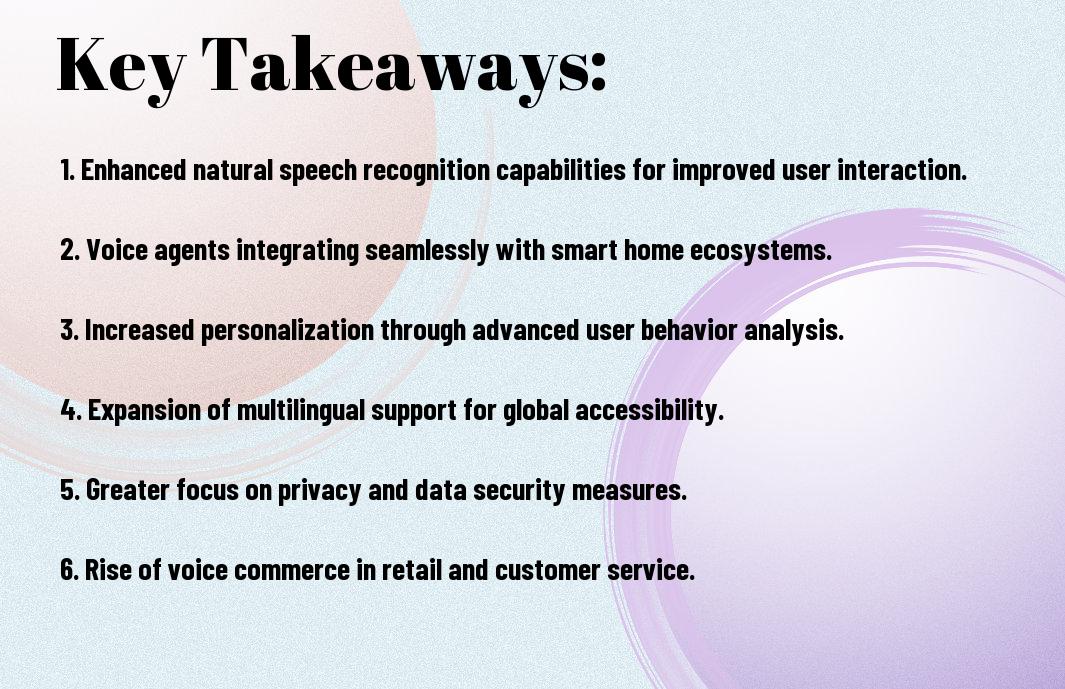
- Personalization: AI voice agents will increasingly utilize data to create tailored experiences for individual users, enhancing engagement and satisfaction.
- Multimodal Interaction: Future voice agents will support seamless integration with various devices and interfaces, enabling users to interact through voice, text, and visuals.
- Emotional Intelligence: Advances in AI will lead to voice agents that can better understand and respond to human emotions, resulting in more natural and effective conversations.
- Privacy and Security: As voice technology evolves, developers will prioritize robust security measures and transparent data usage policies to build user trust.
- Wider Accessibility: AI voice agents will become more inclusive, offering support for diverse languages, dialects, and accessibility features for individuals with disabilities.
Evolution of AI Voice Agents
To understand the future of AI voice agents, it’s necessary to explore their evolution. These intelligent systems have come a long way, from simple command recognition software to advanced conversational interfaces that can understand context and emotions. As you look ahead, you’ll notice how important this evolution has been in shaping user experience and enhancing productivity in personal and professional contexts.
Historical Development
About the journey of AI voice agents, it began in the 1950s with early speech recognition systems. Initially, these systems could only recognize limited commands. Over the decades, significant strides were made, including the introduction of natural language processing and machine learning techniques, allowing agents to comprehend and respond to a variety of speech patterns and user intents.
Key Technological Advancements
Voice recognition technology has significantly improved, allowing for higher accuracy and faster responses. Additionally, advancements in natural language processing (NLP) and deep learning have enabled AI voice agents to understand context, manage multi-turn conversations, and provide personalized experiences based on user preferences.
Considering the future, the continued fusion of AI voice agents with other emerging technologies like augmented reality (AR) and the Internet of Things (IoT) will redefine how you interact with your environment. Enhanced language understanding capabilities will lead to more seamless and intuitive exchanges, mirroring human interactions. As these agents become more embedded in your daily routines, their ability to learn from your habits will create a more personalized experience, making them indispensable tools for efficiency and convenience.
Current Trends in AI Voice Technology
Now more than ever, AI voice technology is making significant strides, becoming an integral part of everyday life. With advancements in natural language processing and machine learning, voice assistants are not only improving their accuracy but also expanding their capabilities. As a result, you can expect to see enhanced interactions, more device compatibility, and intelligent behavior adaptation in the years to come.
Personalization and User Experience
Against a backdrop of increasing demands for personalization, AI voice agents are evolving to offer customized experiences tailored to individual preferences. These systems are learning to recognize your unique voice patterns, habits, and requests, allowing for a more intimate and relevant interaction every time you engage with them.
Integration with Smart Home Devices
One of the most exciting developments in AI voice technology is its integration with smart home devices. This trend not only streamlines the user experience but also enhances the overall functionality of your smart ecosystem.
For instance, as voice agents become more adept at communicating with your smart appliances, you can control your home environment effortlessly. You might adjust your thermostat, turn off lights, or play your favorite music simply by speaking commands. Moreover, these integrated systems will enable automation based on your preferences and routines, making it easier than ever to manage your home with minimal effort.
Anticipated Innovations by 2025
Despite the rapid advancements in AI voice agents, the future holds even more exciting innovations. By 2025, you can expect voice agents to integrate seamlessly with various aspects of your life, enhancing user experience and personalization. For insights into these developments, check out 5 Generative AI Trends to Watch in 2025, which highlights how generative AI will elevate voice interactions.
Natural Language Processing Improvements
Behind the scenes, groundbreaking advancements in natural language processing (NLP) will significantly enhance how your voice agents understand and respond to you. Improved algorithms and language models will ensure fluid, intuitive conversations, allowing these agents to discern nuances in your speech and provide more accurate responses.
Emotional and Contextual Understanding
Between the realms of technical proficiency and human interaction lies your voice agent’s ability to comprehend emotions and context. As these technologies evolve, they will better interpret your tone, sentiment, and context, making your interactions more meaningful and human-like.
Emotional intelligence in AI voice agents is set to revolutionize user experience by allowing for deeper connections and relevance in communication. This capability will enable your voice agents to respond not just based on keywords but by truly understanding your feelings and the context of your requests. Imagine how much more satisfying it will be when your AI can recognize when you’re frustrated and adjust its tone and responses accordingly, creating a more empathetic and tailored interaction.
Ethical Considerations and Challenges
Not addressing the ethical implications of AI voice agents can lead to a myriad of societal issues that could impact your daily life. As these technologies evolve, concerns around transparency, accountability, and the potential misuse of AI are becoming increasingly pressing. You should be aware that the responsible implementation of voice agents will require a concerted effort to balance innovation with ethical standards, ensuring these systems serve humanity without compromising individual rights.
Privacy and Data Security
One of the primary concerns with AI voice agents is the handling of your personal data. As these systems often rely on vast amounts of data to function effectively, ensuring that your information remains secure becomes paramount. You must consider how your conversations may be stored or analyzed, emphasizing the necessity for rigorous data protection measures and transparency from companies regarding their data practices.
Bias and Fairness in AI
About the impact of bias in AI voice agents, it is necessary to recognize that these technologies can inadvertently perpetuate societal biases inherent in their training data. As a user, you may encounter skewed responses or unsuitable recommendations that don’t align with your values or needs. Understanding the sources of these biases helps you become a more informed consumer of AI technology.
Even minor biases in AI systems can lead to significant consequences, affecting your experience and the decisions made on your behalf. Datasets used to train voice agents often reflect historical inequalities, which means that the algorithms may amplify existing stereotypes or exclude minority groups. Ensuring fairness in AI involves continuous audits and updates to the training data, striving to create an equitable user experience and fostering inclusivity in AI technology. As AI continues to evolve, staying informed about these issues will empower you to demand accountability from developers and companies.
Industry Applications and Insights
Once again, AI voice agents are set to transform numerous industries by enhancing efficiency and user experience. Your organization can leverage these technologies to streamline operations, personalize interactions, and deliver real-time insights. From healthcare providers to customer service representatives, voice agents are making significant inroads in how you connect with clients and manage resources, ultimately delivering improved outcomes and greater satisfaction across the board.
Healthcare
Across the healthcare sector, AI voice agents are revolutionizing patient engagement and care delivery. They can assist with appointment scheduling, medication reminders, and even provide critical health information, making it easier for patients to manage their well-being. As a health professional, you can harness these tools to enhance communication, reduce administrative burdens, and improve patient outcomes effectively.
Customer Service
Any business can benefit from AI voice agents in customer service, providing 24/7 assistance and handling a multitude of inquiries efficiently. These agents can reduce wait times, allowing you to focus on more complex issues requiring human intervention, ultimately enhancing customer satisfaction.
Understanding the role of AI voice agents in customer service goes beyond just efficiency; it affects how your customers perceive your brand. By offering prompt and accurate responses, you build trust and loyalty, ensuring that clients feel valued and supported. Moreover, AI voice agents can analyze data from customer interactions, providing you with valuable insights to refine your services and tailor your offerings to meet customer needs more effectively.
Future Market Landscape
Keep an eye on the evolving market landscape for AI voice agents as technological advancements and consumer needs drive demand. By 2025, you can expect significant growth fueled by innovations in natural language processing and machine learning. Explore insights in this 📈Top 10 AI Trends Shaping the Future in 2025, outlining how these elements will shape the market’s future
Emerging Players
Beside the established tech giants, numerous emerging players are entering the AI voice agent market, bringing fresh ideas and a competitive edge. Startups are innovating at a remarkable pace, focusing on niche solutions tailored to specific industries. Your engagement with these new entrants can unlock opportunities for better services and unique functionalities.
Investment Trends
Trends in investment signal a growing confidence in the AI voice agent sector, driven by robust consumer adoption. Major stakeholders are increasingly allocating resources to enhance technology and drive innovation.
In fact, venture capitalists are recognizing the potential of AI voice agents, leading to substantial funding rounds for promising startups. Wave after wave of investment is expected as companies seek to refine their voice functionality, making it more intuitive and versatile. You will likely see a focus on developing solutions for various industries, which could enhance user experience and expand the market further.
Conclusion
As a reminder, the future of AI voice agents will undoubtedly reshape your interactions with technology by 2025. You should anticipate more personalized experiences, improved natural language processing, and enhanced security features that cater to your specific needs. The trends suggest that these advancements will empower you to streamline daily tasks and make your digital interactions more efficient. Staying informed about these developments will help you leverage AI voice agents effectively and enhance your overall productivity.
Q: What are some emerging trends in AI voice agents expected by 2025?
A: By 2025, several trends are expected to shape the development of AI voice agents. Firstly, we can anticipate greater contextual awareness, allowing voice agents to understand user intent and surrounding circumstances better. This will enhance their ability to handle complex queries and provide more personalized responses. Secondly, multi-modal interactions will become more prevalent, where voice agents can seamlessly integrate vocal commands with visual elements, making interactions richer and more intuitive. Lastly, the integration of advanced emotional intelligence capabilities will enable voice agents to detect user emotions through speech patterns, allowing them to respond in a more empathetic and tailored manner.
Q: How will AI voice agents impact daily life and work by 2025?
A: By 2025, AI voice agents are expected to significantly transform both daily life and work environments. In everyday life, people may rely on voice agents for a broader range of tasks, from managing smart home devices to assisting with cooking and personal well-being. Enhanced convenience and efficiency will likely lead to increased adoption among various demographics. In professional settings, voice agents could streamline communication and collaborative workflows, enabling voice-activated note-taking, meeting summaries, and task management. This greater integration into both personal and professional spheres is likely to drive productivity and improve quality of life.
Q: What challenges might AI voice agents face as they evolve towards 2025?
A: As AI voice agents advance towards 2025, they will encounter several challenges. Privacy and security concerns will remain at the forefront, as users become more cognizant of the data collected by these agents and the potential for breaches. Developers will need to prioritize robust data protection measures to gain user trust. Additionally, achieving high levels of accuracy in voice recognition across different accents, languages, and dialects will pose a significant challenge, necessitating advanced machine learning algorithms and diverse training datasets. Finally, balancing the need for personalization with ethical considerations regarding user manipulation and dependency will require careful navigation by AI developers and companies.